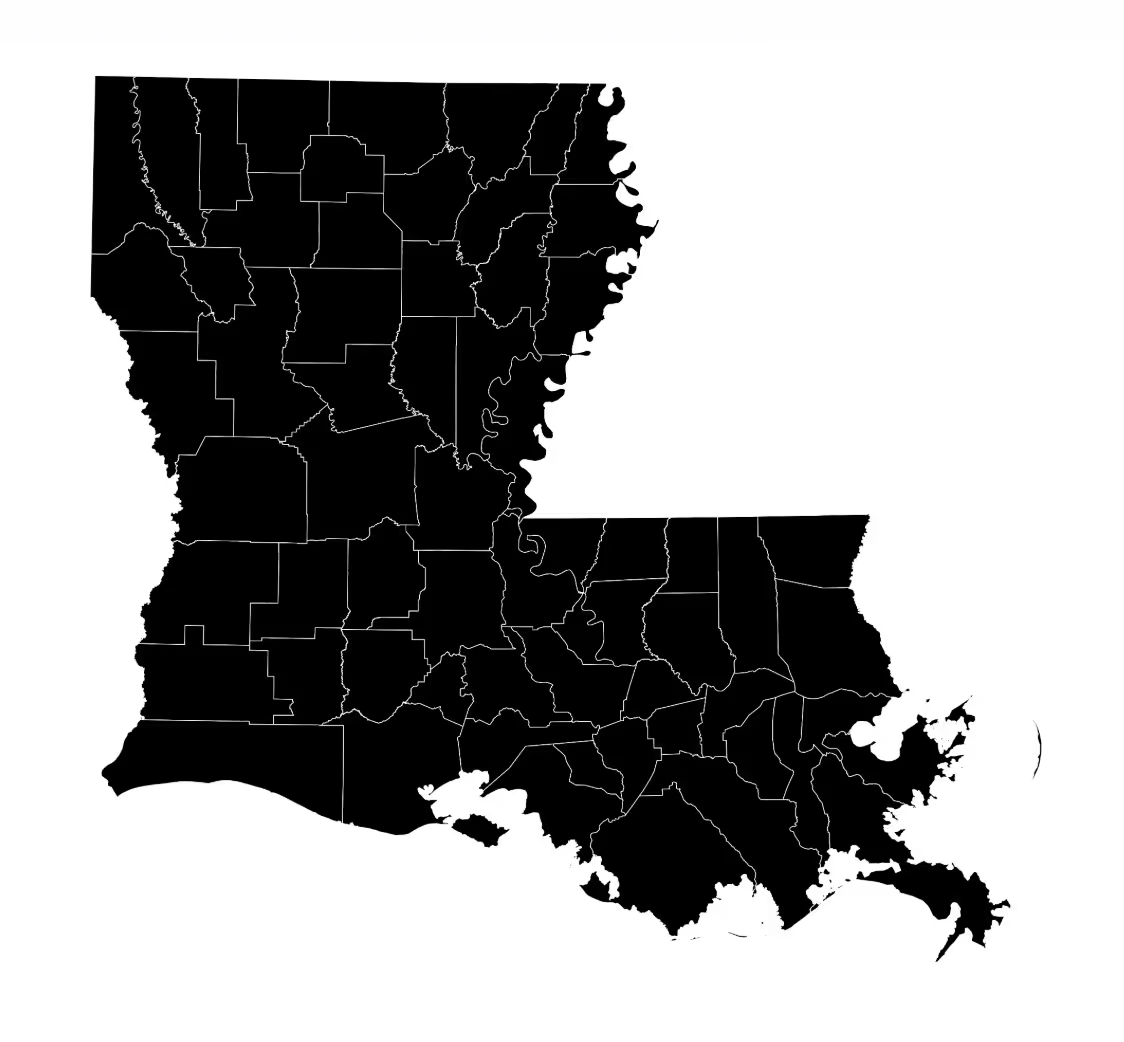
STATE GUIDE: LOUISIANA

Registered Apprenticeship Programs in Louisiana

Louisiana is a State Apprenticeship Agency (SAA) state. Program registration runs through the Louisiana Workforce Commission (LWC), not the federal Office of Apprenticeship, and every new program must be reviewed by the State Apprenticeship Council before it can be approved. That adds time. 

For non-union contractors working on IRA projects, the state's 90-day review window, limited apprenticeship infrastructure, and $100+ billion industrial construction pipeline create a situation where demand for compliant apprentices far outpaces supply.
Registered Apprenticeship Programs in Louisiana

Louisiana at a Glance

SAA State
Governing Body

Louisiana Workforce Commission (LWC), Apprenticeship Division

Key Regulations

La. R.S. 23:381-392 · LAC Title 40, Part IX · 29 CFR Parts 29 & 30

Avg. Registration Timeline (DIY)

3 to 7 months (90-day state review plus preparation and Council approval)

Reciprocity within the Region (Neighboring States)
State
Without Apprentix
With Apprentix

Arkansas

b
A

Mississippi

b
A
Grades reflect ease of activating reciprocity from Louisiana. A = straightforward, F = extremely difficult or not available.
Your Options

4 Ways to Meet Apprenticeship Requirements in Louisiana

Louisiana contractors on IRA projects have the same four paths to apprenticeship compliance as contractors in any state. But the state's unique combination of a slow registration process, thin apprenticeship supply, and enormous project volume changes the calculus on which path makes sense.

Option 01

Good Faith Exemption

Under the Good Faith Exemption, you can satisfy the IRA's apprenticeship requirement without actually employing apprentices. The process works like this: you submit a written request to a registered apprenticeship program at least 45 days before you need apprentices. If that program says no or simply does not respond within 5 business days, the exemption covers you for up to 365 days.

Louisiana has only about 48 registered apprenticeship programs and roughly 3,500 active apprentices statewide, spread across more than 50 occupations. That is a remarkably small pool relative to the volume of construction happening in the state. A formal request that goes unfilled is not unusual here, which makes the documentation case for the exemption stronger than in states with more developed apprenticeship networks.

1

If a program can partially fill your request, you must accept the apprentices they send. The exemption only applies to the portion they cannot fill

2

Your records need to be thorough. Every request, every response, every date must be documented

3

Tax credit buyers and developers view GFE reliance as a risk, because the recapture exposure falls on them if the IRS rejects the claim

4

No enforcement precedent exists yet, so no one can say with certainty how the IRS will treat these claims in audit

More defensible in Louisiana than in most states given the limited apprentice supply. But actual program registration is still the safer long-term play.
Option 02

Register Your Own Program

You can register a program directly with the LWC Apprenticeship Division. An Apprenticeship Navigator walks you through developing your Standards of Apprenticeship, Work Process Schedule, Related Technical Instruction plan, and selection procedures. Once everything is submitted, the Director has 90 days to review your application before forwarding it to the State Apprenticeship Council for a recommendation. The Director then issues final approval.

That 90-day review window is just the state's processing time. Factor in the weeks or months of preparation beforehand, and the realistic end-to-end timeline is closer to 3 to 7 months. Louisiana does not use the federal 30-day shot clock that applies in OA states.

1

The State Apprenticeship Council must review every new program before it can be approved, adding a step that does not exist in many other states

2

Programs with 5 or more apprentices need a written Affirmative Action Plan under 29 CFR Part 30

3

Changes to your approved standards must be processed within 45 days through the division

4

You carry full sponsor liability for compliance, reporting, and audit preparation

The slowest registration path of any state covered in this guide. If your project timeline is tight, this is a risky bet.
Option 03

Use Union Labor

Louisiana is a right-to-work state under both the state constitution (Article I, Section 17) and statute (RS 23:981-987). Overall union membership sits around 4%, and construction unionization is estimated below 10%. The state also bans government-mandated Project Labor Agreements on public construction.

That said, union apprenticeship infrastructure is more established in Louisiana than in some other Southern states, particularly in the electrical and pipe trades. IBEW locals in New Orleans, Baton Rouge, and Shreveport run electrical JATCs. UA locals operate pipe trades programs in New Orleans, Baton Rouge, and Lake Charles. IUOE Local 406 covers heavy equipment operators statewide. But this capacity is concentrated in skilled industrial trades and cannot absorb the volume of IRA-qualifying work flowing through the state.

1

Union agreements lock you into specific wage scales, work rules, and hiring hall procedures

2

Crew selection and labor cost flexibility disappear

3

Existing union apprentice capacity cannot keep pace with Louisiana's construction boom, particularly outside the industrial corridor

Louisiana's construction workforce is over 90% non-union. Union labor is an option for some, but not a scalable one.
Option 04

Join a Registered Program

The alternative to building your own program or converting to union labor is to register under an existing one. A program sponsor that already holds LWC or DoL approval adds your company as a participating employer. Your apprentices train under their standards. The sponsor takes on the compliance work.

In a state where DIY registration can take half a year, this path eliminates the wait entirely. No LWC application, no Council review, no months of back and forth on documentation. Your apprentices are registered and logging compliant hours immediately.

1

Apprentice registration happens the same day, with certificates following quickly

2

No state application process, no Council approval wait, no sponsor liability on your end

3

The sponsor handles all compliance management, reporting, and DoL filings

4

One program covers you across every state where the sponsor holds reciprocity

Same-day registration. Compliance handled for you. Work in any state.

Same-day registration. Certificate in hand within days.

Apprentix puts contractors into a registered program that already has approval. No LWC application, no Council review, no 90-day wait. You are counting compliant hours from day one.

Get Started →
Compliance

Staying Compliant in North Carolina

Registration is the starting line. The real work is maintaining compliance as your project runs. Louisiana follows federal standards under 29 CFR Parts 29 and 30, with the LWC Apprenticeship Division handling state oversight and all data managed through the federal RAPIDS system.

Apprentice registrations, completions, cancellations, and transfers must be submitted promptly to the division. The LWC conducts program reviews on a rolling basis, generally targeting each program at least once every five years, with higher-risk programs reviewed more often. The State Apprenticeship Council can also initiate deregistration proceedings when it finds reasonable cause for non-compliance.

On IRA projects, tracking requirements are more granular. Total labor hours must be documented by trade across the entire project, with apprentice labor hours broken out separately. The 15% apprenticeship threshold is measured project-wide, not per contractor. Apprentice-to-journeyworker ratios must be tracked daily, by trade. Louisiana's 1:1 cap gives contractors room to deploy apprentices, but hours worked on any day where the ratio is out of line will not count toward the 15% target.

Wage progression must follow a schedule that increases over time, tied to on-the-job training milestones. On IRA prevailing wage projects, apprentice pay must meet at least the percentage of the applicable Davis-Bacon rate outlined in their registered program. Louisiana repealed its state prevailing wage law in 1988, so Davis-Bacon is the only prevailing wage obligation on IRA projects here.

All records must be kept for at least 5 years. IRS Form 7220 requires reporting of worker counts, wages paid, apprentice counts, and labor hours for every contractor and subcontractor involved. The taxpayer bears the burden of proof.

Compliance, handled.

Apprentix allows contractors to register apprentices, track their training hours, monitor wage increases, and keep their program compliant with the DoL, so nothing falls through the cracks.

Learn More →
Penalties

What happens if you're non-compliant.

Louisiana has modest state-level penalties for apprenticeship violations: up to $500 per violation under RS 23:392, plus potential litigation costs up to $7,500. The LWC can also deregister a non-compliant program. But those numbers are small compared to what the IRS can do.

$50–$500+

Per non-compliant labor hour (IRA)

The IRS charges $50 for every labor hour that falls short of the 15% apprenticeship threshold. If the shortfall is deemed intentional disregard, the penalty jumps to $500 per hour. On Louisiana's multi-billion-dollar industrial and clean energy projects, even a short period of non-compliance can create enormous exposure.

Debarment

From federal contracts

Davis-Bacon violations can trigger DoL debarment. Hiring a debarred contractor increases the IRS's scrutiny of the entire project.

No retroactive fix

Unlike prevailing wage underpayments, which can sometimes be corrected after the fact, apprenticeship shortfalls are permanent. Non-compliant hours stay non-compliant. There is no cure period. That creates cascading problems: project financing stalls, credit transfers get blocked, and disputes between contractors, developers, and investors multiply.

The biggest hit is to the tax credit itself. Without meeting prevailing wage and apprenticeship requirements (or paying the penalties), the taxpayer receives one-fifth of the full credit. On a project eligible for the 30% ITC, that drops to 6%. On a $100M project, you lose $24 million. In Louisiana, where billions in IRA-eligible carbon capture, hydrogen, and clean energy projects depend on those credits to pencil out, the stakes could not be higher.

The cost of finding out too late is measured in millions.

Apprentix allows contractors to register apprentices, track their training hours, monitor wage increases, and keep their program compliant with the DoL, so compliance issues surface before they become penalties.

Talk to Us →
Apprentix

How Apprentix Helps Contractors in Louisiana

Louisiana is in the middle of the largest industrial construction boom in its history, and contractors on IRA-qualifying projects need apprenticeship compliance now, not in six months. Apprentix solves that problem. As your Fractional Sponsor, we hold the registered apprenticeship program and carry the sponsor liability, so your team stays focused on building.

Same day

Registration

Registration Join Apprentix's existing registered program and start counting hours the same day. Certificate in hand within days.

30 days

Interstate Expansion

Start work on projects in new states within 30 days, versus the months it takes to register independently.

Compliance done for you

One platform to register apprentices, track training hours, monitor wage increases, and stay compliant with the DoL, no matter how many states you operate in. You see where every project stands, and alerts fire before anything goes sideways.

No need to change how you work

Your crews already train on the job. Apprentix formalizes what you are already doing and maps it to DoL standards so it counts. Nobody goes to school. Nobody pays tuition. Nobody loses time on the project. Electricians are the one exception, where a third-party curriculum is required. We have affordable, online options we can connect you with.

Resources

Louisiana Apprenticeship Resources

Louisiana Workforce Commission, Apprenticeship Division
DoL Office of Apprenticeship, Dallas Regional Office
  • Regional Director: Dudley Light
  • Phone: (972) 850-4682
  • Address: 525 S. Griffin Street, Room 317-L, Dallas, TX 75202
Winning bids without hassle

“We struggled to manage our apprenticeship program on our own, but Apprentix took over the compliance, tracking, and registration—we are able to win bids without any hassle.”

Joel G.
General Contractor in Texas
View Reviews
Apprentix is a platform for all contractors to start and run apprenticeships, build phenomenal talent, and stay compliant with the IRA.

Founded in 2022 by a business owner running apprenticeships, we’ve set up 100s of businesses across the U.S. to run darn-near effortless apprenticeships. We’ve accomplished this through our proprietary Technology Platform and  Fractional Services model.

1k+
Businesses
All 50
States
55k+
Occupations
20k+
Apprentices
View Stories

Ready to Get Started in Louisiana?

Louisiana's construction boom will not wait for a 90-day application review.
Talk to our team about getting your apprenticeship program live today.
FAQ

Frequently asked questions.

Is Louisiana a state apprenticeship agency (SAA) state?

Yes. Louisiana is one of roughly 25 SAA states. The Louisiana Workforce Commission registers all apprenticeship programs, and the State Apprenticeship Council reviews every new set of program standards before the Director issues approval. This is a different process than in federal OA states, where the U.S. Department of Labor handles registration directly.

How long does it take to register an apprenticeship program in Louisiana on your own?

Longer than most states. The LWC Director has a 90-day window just to review a completed submission, and that does not include the time spent developing Standards of Apprenticeship, coordinating with your assigned Navigator, or waiting for Council review. Start to finish, most contractors should plan for 3 to 7 months. Louisiana does not use the federal 30-day shot clock.

What apprentice-to-journeyworker ratios apply in Louisiana?

Louisiana caps all construction occupations at 1:1 under LAC Title 40, §IX-301. That means no more than one apprentice per journeyworker on any jobsite. Individual programs may set lower ratios, but the ceiling is uniform across trades. For IRA compliance, the ratio that matters is the one established in your specific registered program, and it must be maintained daily.

Does Louisiana have its own prevailing wage law?

No. Louisiana had a state prevailing wage law but repealed it in 1988. On IRA projects, the only prevailing wage obligation is the federal Davis-Bacon rate. There is no additional state wage layer, which simplifies compliance compared to states that enforce their own prevailing wage on top of federal requirements.

Can I rely on the Good Faith Exemption for IRA projects in Louisiana?

More easily than in most states. Louisiana's small apprenticeship system (about 48 programs and 3,500 apprentices statewide) means formal requests to programs are more likely to go unfilled or be denied, which strengthens your exemption documentation. 

But the exemption is still a paper-based defense, not actual compliance. Developers and tax credit investors increasingly prefer contractors who are registered under a real program. For long-term projects, joining an existing program through a sponsor like Apprentix is the more reliable strategy.

What states and occupations does Apprentix cover?

Apprentix holds certified National Guideline Standards issued by the Department of Labor across 48 states in 7 occupations: Construction Craft Laborer, Heavy Equipment Operator, Electrician, Pipefitter, Surveyor, Wind Turbine Technician, and Carpenter (Form Builder). Coverage excludes California (no state projects, IRA-only ok) and New York.

How much does it cost to work with Apprentix?

The Fractional Sponsor service starts at $13,000 per year for up to 20 active apprentices and includes all DoL filings, audit management, and full access to the Apprentix platform for tracking and visibility.